TKDN Website — Kemenperin, Ministry of Industry
The public face of domestic-content certification — from a PHP 5 certificate bulletin to Sistem Informasi P3DN: a live, API-verifiable registry served by a Rust frontend and a Go headless CMS.
- Year
- 2026
- Focus
- Government
- Reading
- 6 min· 11 sections
- Published
- Web


Project Overview
"A certificate registry lives or dies on trust. Every era of this platform was ultimately about making "is this TKDN number real?" a question a computer can answer in milliseconds."
The Evolution — 2 Eras, One Mission
Every rewrite preserved the program’s core workflow while replacing the foundation underneath it.
01. PHP — The Legacy Certificate Site · 2020 — 2026
Six years of server-rendered PHP: certificate submissions, public lookups, and the search.php / rekap.php / sertifikat_ik_idx.php surfaces that served the registry until the 2026 rebuild.
02. Rust + Go — The Headless CMS · 2026 — Present
The current tkdn.kemenperin.go.id — Sistem Informasi P3DN — runs on a purpose-built CMS: a Rust-compiled frontend over a Go content API, serving certificates, regulations, infographics, and the org structure itself.
One rebuild — six years of PHP straight to a headless CMS.
Certificate lookup and API verification for procurement systems.
PHP, Rust, and Go across the two generations.
Rust frontend over a Go headless CMS — Sistem Informasi P3DN.
Era 01 · 2020 — 2026 — PHP — The Legacy Certificate Site
Era 02 · 2026 — Present — Rust + Go — The Headless CMS
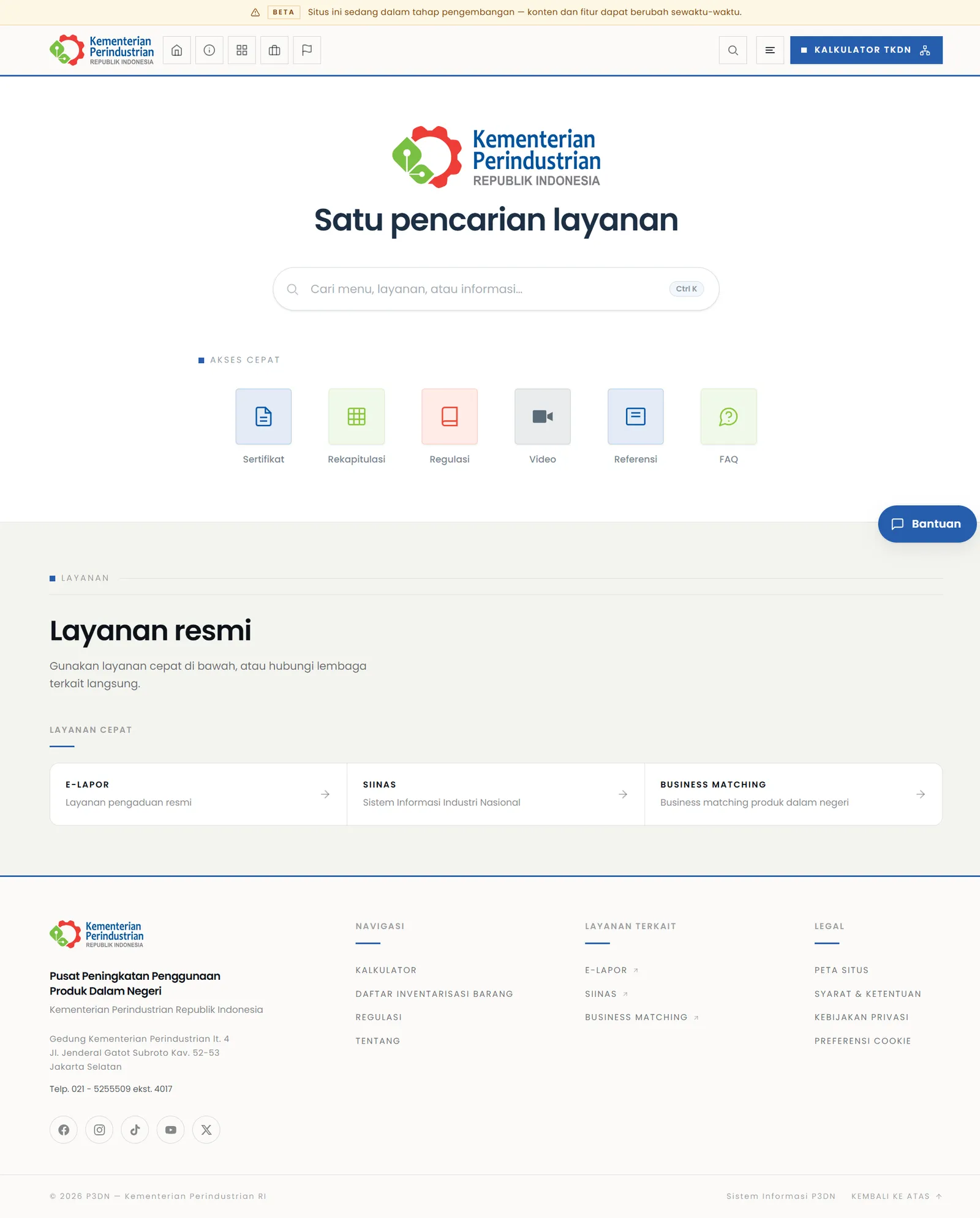
Satu Pencarian — one search over every P3DN service
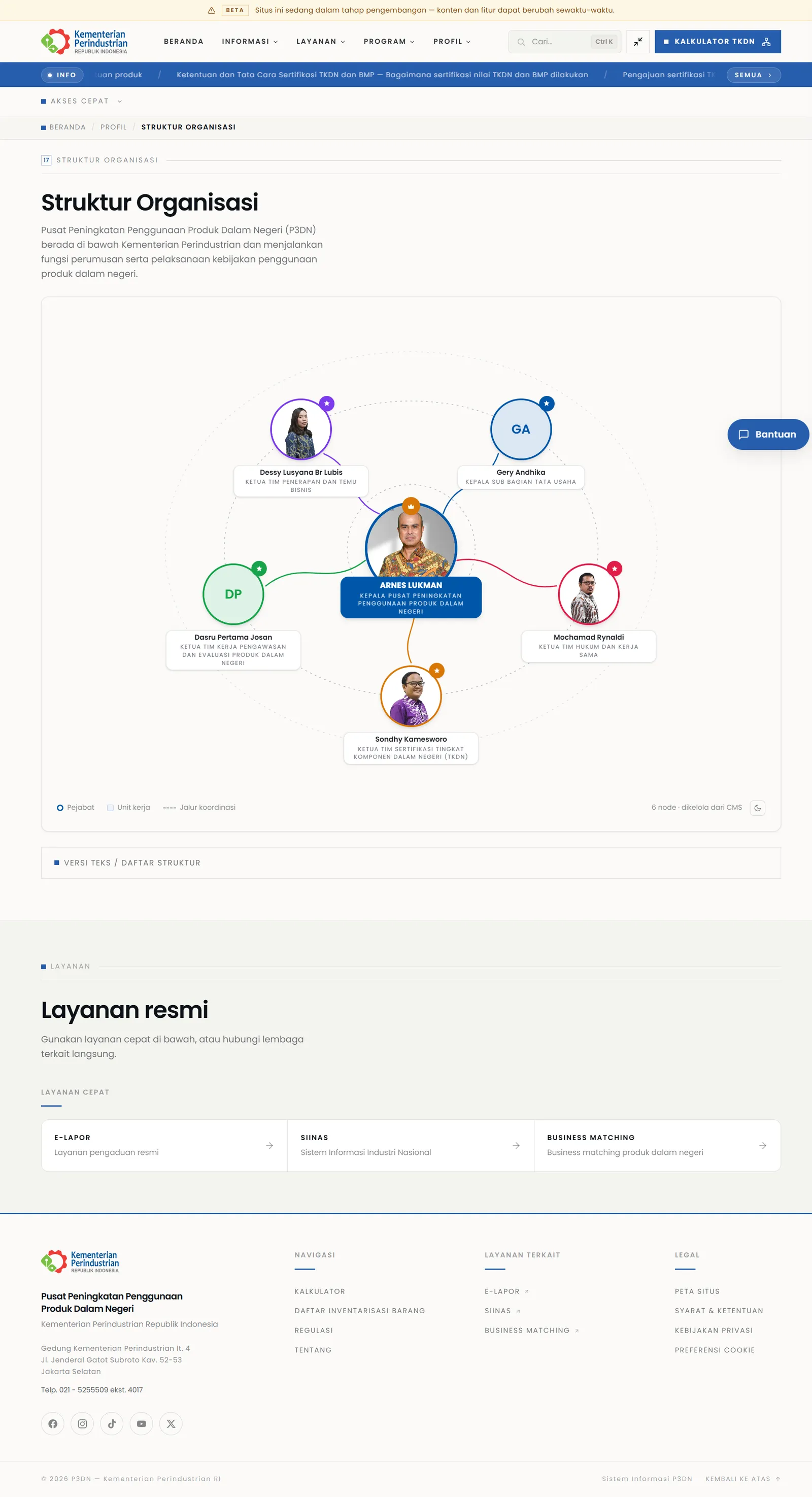
Struktur Organisasi — rendered from CMS nodes
The CMS in Production
A Rust frontend over a Go content API — every public surface on tkdn.kemenperin.go.id reads from the same editorial pipeline.
Inside the Build
Why Rust in front and Go behind — and what each side owns.
Rust Frontend — Compiled, Not Interpreted
The CMS frontend is authored in Rust and ships to the browser as WebAssembly. Authoring surfaces — the unified service search, the org-chart renderer, faceted certificate filtering — run native-grade without a JavaScript runtime tax.
Go Backend — One API, Every Surface
A single Golang service exposes the content API: typed models for pages, regulations, infographics, news, and the org structure. Publishing flows through one REST contract, so every public surface stays consistent with one editorial change.
Certificate Directory — Synced, Not Entered
Certificate data is never re-keyed into the CMS. The directory syncs TKDN and LVI records from SIINas — the 143,980-certificate registry stays a data product, and the CMS only renders it.
Content as Structure, Not Pages
The organizational chart on the Profil page is rendered from CMS-managed nodes — people, roles, and coordination lines as data. Structure lives in the model, so the site can render it as a graph, a list, or an API response.
Total TKDN/BMP certificates in the registry across 2020–2026.
Certificates still inside their validity window.
Mean domestic-content score across valid certificates.
LVI partners issuing — Surveyor Indonesia, Sucofindo, Anindya, BSKJI, BKI.
The Public Sitemap
Distilled from the program’s DOKUMENTASI SITEMAP (October 2026) — the eight surfaces the CMS renders, plus global header/footer with LVI contacts.
Home
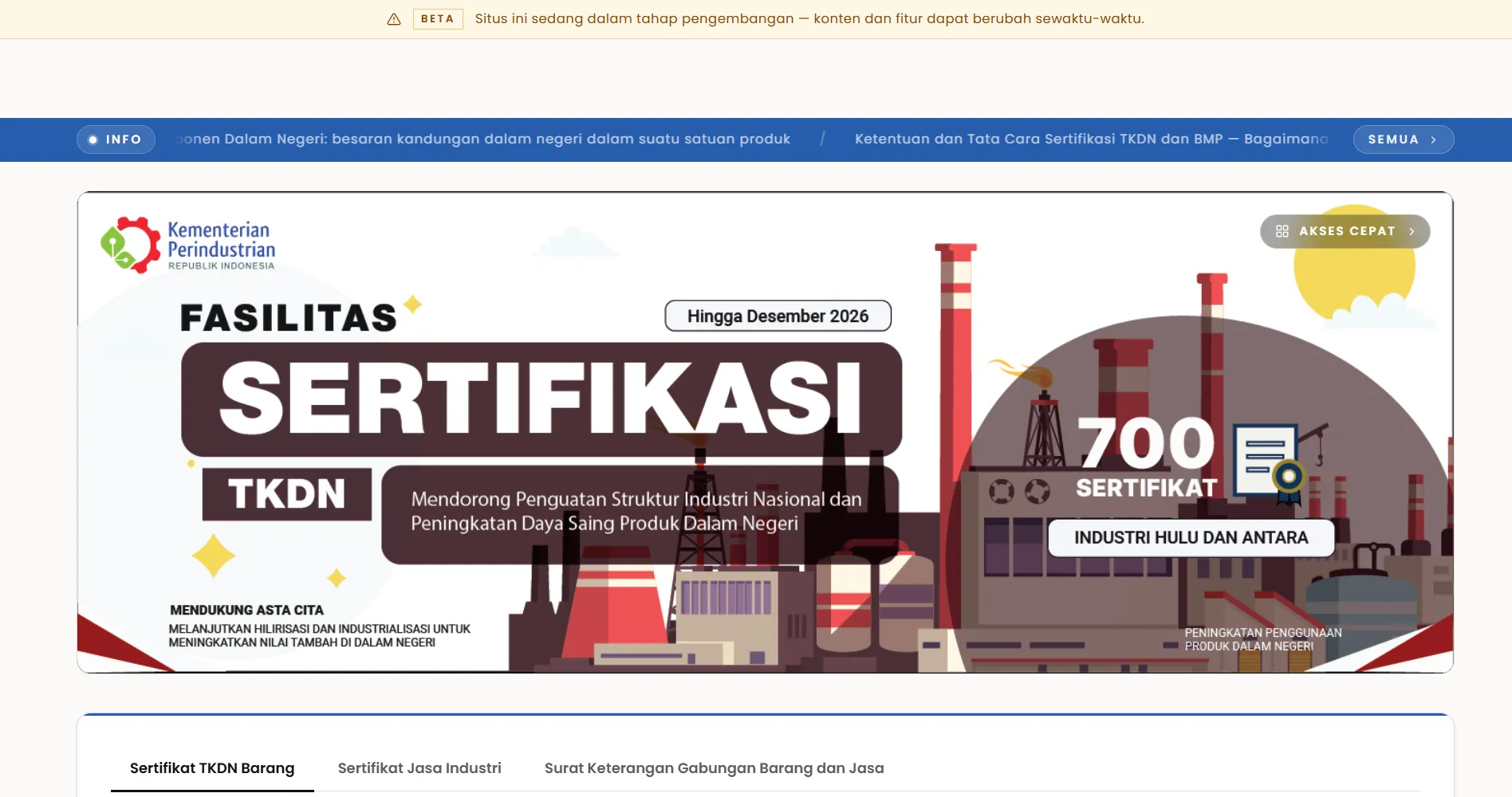
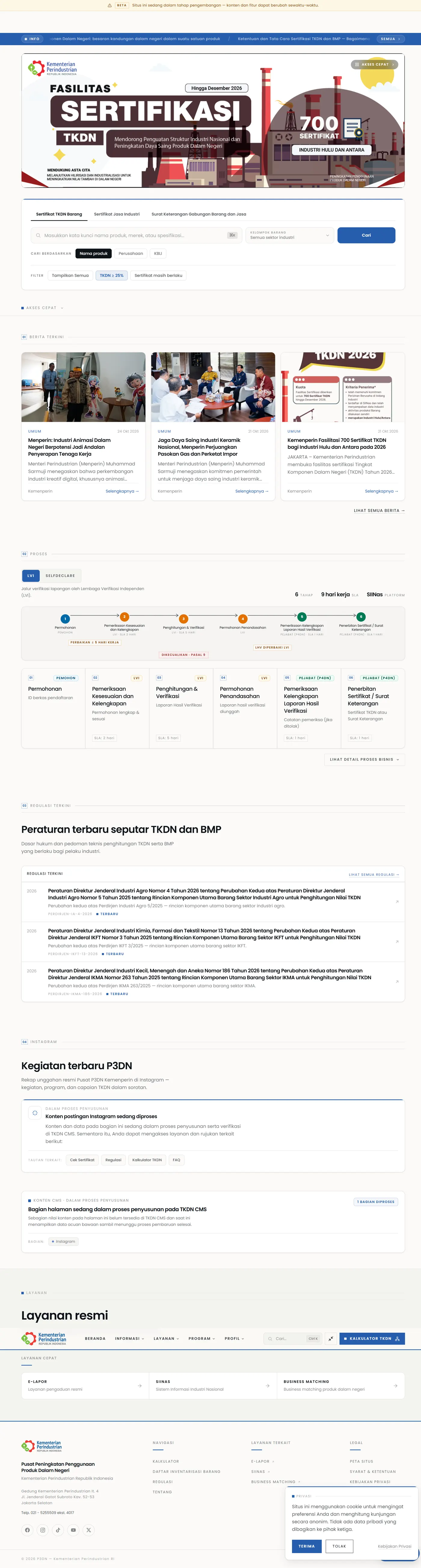
Fasilitas Sertifikasi hero, certificate search entry, latest news, business-process guide, and regulation highlights.
Sertifikat
Faceted search over issued TKDN/BMP certificates — category, commodity group, province, TKDN threshold, and issuance year.
TKDN IK
Industri Kecil certificate directory — filter by issuance year and province, paginated tables of company, product, spec, and TKDN value.
Rekapitulasi
Aggregate tables by commodity group, issuance year, and province — plus downloadable TKDN/LVI and BMP datasets per year.
Infografis
Live registry dashboards — issuance volume per year, certificate status, TKDN value distribution, and top verification bodies.
Regulasi, Video, FAQ, Referensi
The regulation library (UU through Dirjen rules), a video gallery, an accordion FAQ on certification procedures, and a domestic-product reference search.
Certificate Search & Verification

Faceted certificate search — filters, TKDN scores, validity
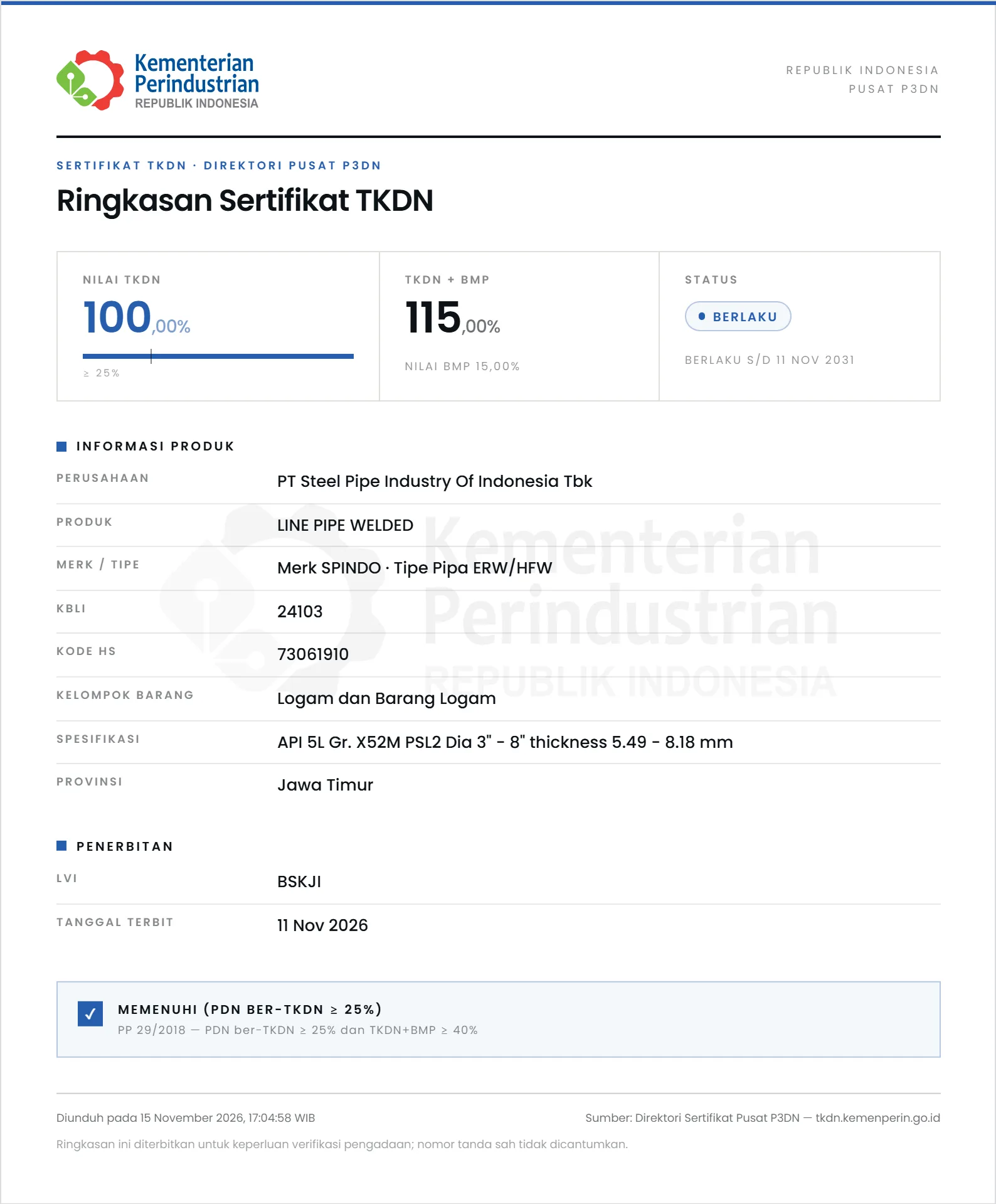
Ringkasan Sertifikat — the procurement-ready verification document
Data Surfaces — Infografis & Rekapitulasi
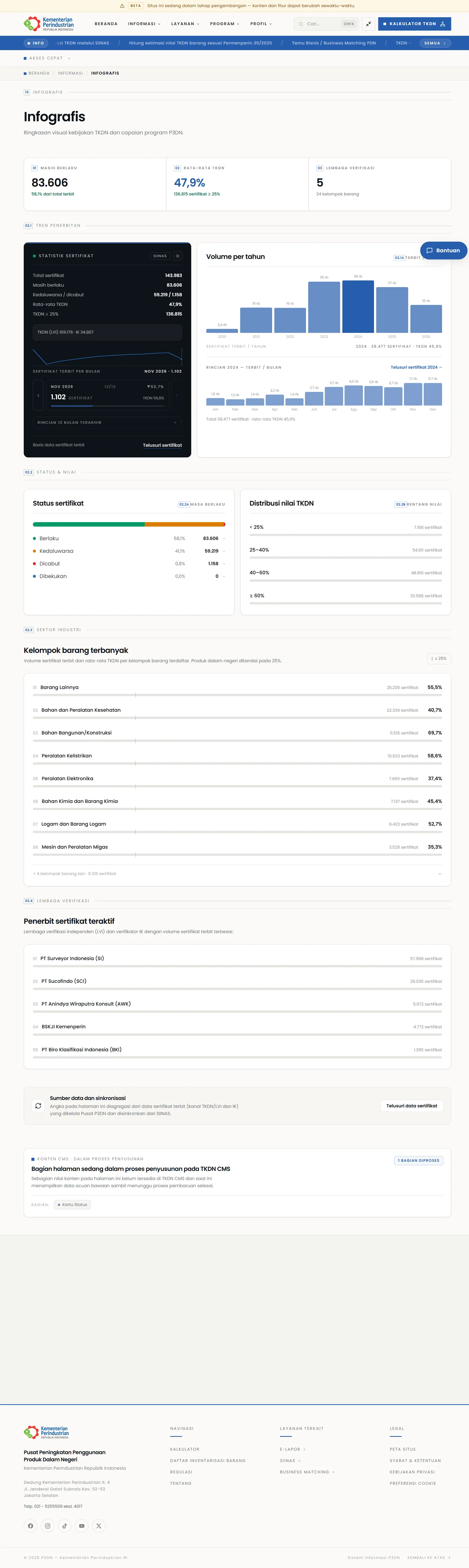
Infografis — the registry as a live dashboard
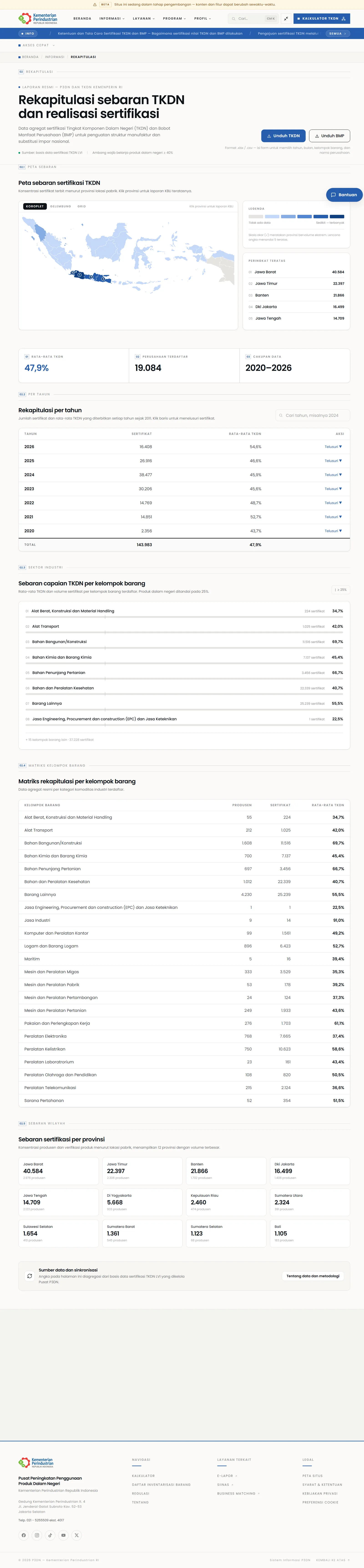
Rekapitulasi — province map, year tables, commodity matrix
Lessons Carried Forward
What the certificate registry taught across two generations.
Trust Is a Latency Problem
A certificate check that takes seconds gets skipped. Indexed lookups and a public verification API made "check the TKDN number" cheap enough to do every time.
Certificates Are Data, Not PDFs
Once the registry stored number, scope, validity window, and calculation breakdown as fields, certificates could be searched, expired, and verified programmatically — the PDF became a rendering, not the record.
Content Shouldn’t Need a Deploy
Six years of server-rendered PHP meant every regulation update and org-chart change shipped through code. The headless CMS made editorial work independent of the engineering cycle.
Sync Beats Re-Entry
Certificate records flow from SIINas into the CMS read model — no staff re-keying, no drift between the registry and the site that presents it.